How to start forex trading as a beginner in 2026 with a structured plan
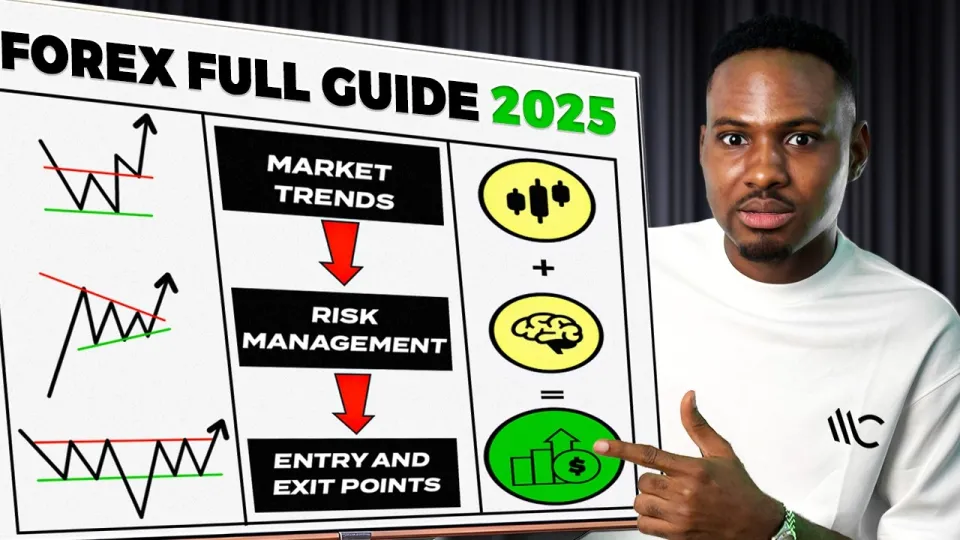
Video: How To Start Forex Trading For Beginners’ 2025 (Full Course)
Need articles like this for your video? They help promote it on YouTube and Google — order them in the Telegram bot @sat_sit_bot. It writes articles around your video, embeds the video and publishes them on popular niche websites (no ads). Try it free: 50 articles on us.
Key takeaways
- Forex is an over-the-counter market where currencies are quoted in pairs and trade 24 hours a day, five days a week.
- Beginners need three things before risking money: a demo account, a trading platform such as MT5 and a written risk rule.
- The market runs four sessions — Sydney, Tokyo, London and New York — and liquidity peaks when London and New York overlap.
- A common beginner risk cap is 1–2% of account equity per trade, which keeps a losing streak survivable.
- Jeffrey Benson Forex offers a full beginner course plus a free daily signal channel at t.me/firepipsignals.
Forex trading for beginners means learning one market, one platform and one risk rule before placing real money: you trade currency pairs on an over-the-counter market that is open 24 hours a day from Monday to Friday, and you size each position so a single loss cannot damage your account. The fastest way to get there is a structured curriculum rather than random videos — Jeffrey Benson Forex publishes a full beginner course and a student program at firepipsfx.com/plans that walks through the same sequence: what forex is, how the market works, which tools you need, a basic strategy, your first trade and the mistakes that cost beginners money.
What forex trading actually is and how currency pairs are quoted
Forex is the exchange of one currency for another, and every price you see is a ratio between two currencies. A quote like EUR/USD 1.0850 means one euro buys 1.0850 US dollars; the first currency is the base, the second is the quote currency, and the number tells you how much of the quote currency you need for one unit of the base. When you buy EUR/USD you are effectively long the euro and short the dollar, so you profit if the euro strengthens.
Three details shape everything a beginner does next:
- Pairs come in groups. Majors (EUR/USD, GBP/USD, USD/JPY, USD/CHF) carry the tightest spreads and the deepest liquidity. Crosses such as EUR/GBP and exotics such as USD/TRY are thinner and more expensive to trade.
- The market is decentralized. There is no single exchange; banks, brokers and liquidity providers quote prices over the counter, and your broker passes those quotes to your platform with a markup called the spread.
- Leverage is a loan, not a bonus. At 1:100 leverage, a $100 deposit controls a $10,000 position — which magnifies both gains and losses by the same factor.
A pip is the standard unit of price movement: 0.0001 for most pairs and 0.01 for yen pairs. A standard lot is 100,000 units of the base currency, a mini lot is 10,000 and a micro lot is 1,000, which is why micro lots are the sensible starting size for a small account.
How the forex market works across the four trading sessions
Forex runs around the clock because the world's financial centres hand off to one another, and the session you trade in determines how much movement and cost you face. The day opens in Sydney, moves to Tokyo, then London, then New York, and closes again before Sydney reopens. London is the largest session by volume, and the overlap between London and New York is where most of the day's range is created.
| Session | Approximate hours (GMT) | Typical character |
|---|---|---|
| Sydney | 21:00–06:00 | Thin, range-bound |
| Tokyo | 00:00–09:00 | Yen and Aussie activity |
| London | 07:00–16:00 | Highest liquidity, strong trends |
| New York | 12:00–21:00 | US data releases, volatility |
Beginners often lose money simply by trading the dead hours: spreads widen, ranges tighten and stop-losses get picked off by noise. Writing the four sessions into a notebook — as several viewers of the course recommend — is more useful than memorising them once, because session timing explains why a strategy that works at 9am London fails at 10pm.
The tools you need before your first trade
A beginner needs four tools and nothing more: a regulated broker, a trading platform, a demo account and a trading journal. Everything else — indicators, signal groups, paid courses — is optional until the basics are automatic.
- A broker account. Choose a regulated entity, check the spread on EUR/USD, the minimum deposit and whether micro lots are available. Jeffrey Benson recommends Assex Markets in the course description and links a registration page at https://my.assexmarkets.com/auth/register?partner_code=1699134; treat any broker recommendation, including his, as something to verify against a regulator's register yourself.
- MetaTrader 5 (MT5). The platform most retail traders use: it holds charts, order types, indicators and a strategy tester. You link your broker account to MT5 with the login details the broker sends you.
- A demo account. Trade the same strategy on demo for at least 20–30 trades before funding anything. The goal is not profit but proof that you follow your own rules.
- A journal. Record entry, exit, size, reason and outcome for every trade. Without it you cannot tell luck from skill.
Beyond that, a chart with a clean price axis, a couple of moving averages and a support-and-resistance habit will carry a beginner further than a screen full of indicators.
A basic strategy foundation and how to place your first trade
A workable beginner strategy is a small set of conditions that repeat often enough to test: a direction filter, an entry trigger and a predefined exit. One simple version is to trade only in the direction of the 50-period moving average on the four-hour chart, enter when price pulls back to a level that has already acted as support or resistance, place the stop beyond the level and target at least twice the stop distance.
Placing the order itself follows a fixed sequence:
- Pick the pair and timeframe, and confirm the higher-timeframe trend.
- Mark the level you are trading from and wait for price to reach it — do not chase.
- Set position size from the stop distance, not from how confident you feel.
- Enter with a market or limit order, then immediately attach the stop-loss and take-profit.
- Log the trade in the journal the moment it closes, win or lose.
Risk management is the part beginners skip and the part that decides survival. Capping risk at 1–2% of equity per trade means ten consecutive losses cost roughly 10–20% of the account rather than most of it. On a $500 account, 1% is $5 of risk, which with a 20-pip stop works out to a micro-lot position — and that arithmetic, not the entry signal, is what keeps a beginner in the game long enough to learn.
Common mistakes beginners make and the questions they keep asking
The mistakes that end most beginner accounts are behavioural rather than technical: oversized positions, no stop-loss, revenge trading after a loss and switching strategies every week. A few recurring doubts from viewers of the course are worth answering directly.
- "Is it too late to start?" No. Currencies move every session regardless of when you begin; what matters is the process, not the calendar.
- "Do I need a big account?" No, but a small account limits how much you can earn. Micro lots let a few hundred dollars trade with correct risk, and the point of the first year is skill, not income.
- "Can I copy someone else's trades instead?" Signal copying exists — the course offers a free daily signal at https://t.me/firepipsignals — but copying without understanding sizing and stops leaves you unable to judge when the signal provider is wrong.
- "How long until I am profitable?" Expect months of demo and small live trading. Anyone promising a fixed timeline is selling something.
A useful test before every trade: if you cannot state the stop, the target and the percentage of the account at risk in one sentence, the trade is not ready.
Useful links from the course
- Student plans and full training: firepipsfx.com/plans
- Free daily signal channel: https://t.me/firepipsignals
- Broker registration referenced in the video: https://my.assexmarkets.com/auth/register?partner_code=1699134
- Premium signal group access bot: https://t.me/jeffreybenzhelpbot
Bottom line on starting forex trading
Forex rewards a boring, repeatable process far more than it rewards enthusiasm: learn how pairs are quoted, respect the session clock, trade micro lots on a demo account until your journal shows consistency, and never risk more than a couple of percent on a single idea. The beginner course from Jeffrey Benson Forex is a practical place to start because it sequences the material in the order a new trader actually needs it — market basics, tools, strategy, first trade, then mistakes. If you want the structured version with student support, the plans are at firepipsfx.com/plans. Treat every link in the description, including the broker, as a starting point for your own due diligence rather than a guarantee.
Source: How To Start Forex Trading For Beginners’ 2025 (Full Course) · Markdown version
Questions & answers
How much money do I need to start forex trading?
You can open an account with a few hundred dollars, and micro lots let you apply 1–2% risk rules on that amount. The realistic constraint is not the minimum deposit but the number of trades you need to learn, so start on demo and fund only what you can afford to lose entirely.
Is forex trading gambling?
It becomes gambling when position size is arbitrary and there is no stop-loss. With a defined entry rule, a fixed risk per trade and a journal to measure results, it is a probabilistic skill game with a measurable edge — or a measurable absence of one.
What is the best time of day to trade forex?
The London session and the London–New York overlap usually offer the tightest spreads and the clearest moves, while the late Sydney and early Tokyo hours are thin and range-bound. Pick one window that fits your schedule and study it consistently rather than trading all day.
Do I need to pay for a course or signals to learn forex?
No, the core material is free, including the full beginner course from Jeffrey Benson Forex. Paid plans and signal groups can speed things up or provide structure, but they cannot replace your own practice on a demo account and your own trade journal.